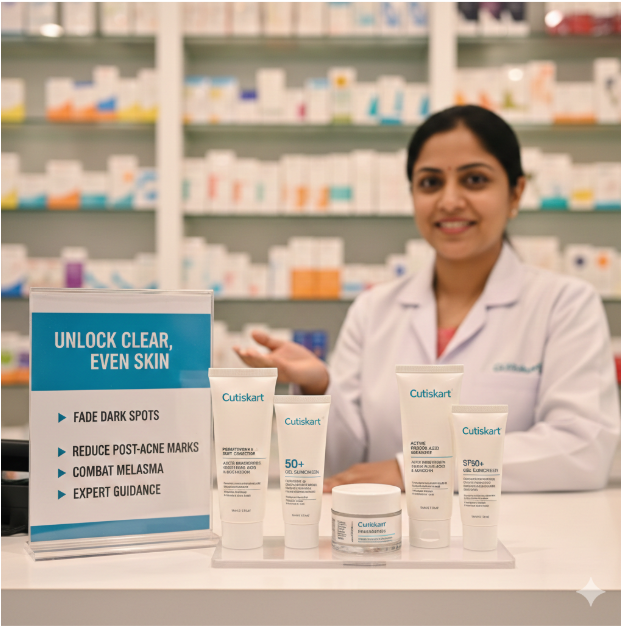
Your dermatologist just handed you a prescription with three product names on it, and now you’re staring at a general shopping app wondering if the “genuine” listing you found is actually the real formulation or a lookalike from an unverified seller. If that’s where you are right now, you’re exactly who this guide is for. Finding dermatologist recommended skincare products online in India shouldn’t mean gambling on authenticity every time you reorder a face wash or a prescription cream, and once you know what to actually check, it doesn’t have to.
This guide walks through what “dermatologist-recommended” really means, where to buy these products safely in India, how a specialised dermatology pharmacy compares to a general marketplace, and how to pick the right products for your specific skin and hair concern.
What Does “Dermatologist-Recommended” Actually Mean?
The phrase gets used loosely, so it’s worth being precise about it. A genuinely dermatologist-recommended product typically falls into one of three categories:
- Prescription-only formulations – medicated creams, gels, and solutions (like tretinoin, hydroquinone, or topical steroids) that require a valid prescription and are dispensed exactly as prescribed, not substituted.
- Clinically formulated OTC products – face washes, moisturisers, and sunscreens built around active ingredients (niacinamide, salicylic acid, ceramides) that dermatologists commonly suggest for specific skin types, even without a prescription.
- Brand lines developed with dermatology input – product ranges designed in consultation with dermatologists for conditions like acne, eczema, or hyperpigmentation, sold both in clinics and online.
The common thread across all three is that they’re chosen for a specific skin concern based on clinical reasoning, not marketing which is exactly why buying them from the wrong source, where formulations can be diluted, expired, or counterfeit, defeats the purpose entirely.
Where to Buy Dermatologist Recommended Skincare Products Online in India
This is the question most people are actually asking, so here’s the direct answer: buy from a platform that sources exclusively from licensed distributors, verifies prescriptions for regulated products, and specialises in dermatology not a general marketplace where third-party sellers list skincare alongside unrelated categories.
| Where You Buy | Authenticity Risk | Prescription Handling | Product Range |
| Specialised dermatology pharmacy (e.g. Cutiskart) | Low – sourced from licensed distributors | Verified upload & pharmacist check | Skin, hair & nail-focused only |
| General e-commerce marketplace | Variable – depends on third-party seller | Often inconsistent or unchecked | Beauty mixed with unrelated categories |
| Unverified social media sellers | High – no accountability if fake | Rarely verified | Limited, inconsistent stock |
If your dermatologist has prescribed something specific, the safest move is ordering from a platform built around dermatology, where the product catalogue itself is curated for skin and hair conditions rather than general beauty trends.
Cutiskart vs Nykaa vs Amazon: Which Is Better for Dermatologist-Recommended Skincare?
This comparison comes up often, and it deserves an honest answer rather than a blanket “ours is best” each platform serves a different purpose:
| Factor | Cutiskart | Nykaa | Amazon |
| Focus | Dermatology-only (skin, hair, nail) | General beauty & cosmetics | General marketplace, all categories |
| Prescription upload | Built into the ordering flow | Not standard for most listings | Varies by seller, often absent |
| Product curation | Dermatologist-tested, sourced from licensed distributors | Broad beauty catalogue, mixed brand tiers | Third-party sellers, quality varies widely |
| Best for | Prescription & clinical-grade dermatology products | Everyday cosmetic and makeup shopping | Convenience buying of known, branded FMCG items |
The honest takeaway: for prescription or dermatologist-recommended clinical products specifically, a dedicated dermatology pharmacy is built for that use case in a way a general beauty or marketplace platform isn’t. It’s not about one platform being universally better, it’s about matching the platform to what you’re actually buying.
Check this comparison also Why Cutiskart is Better Than Apollo & 1mg for Skincare & Derma Products in India
Is Cutiskart Genuine and Safe for Dermatologist-Prescribed Skin Care Products?
Since this is one of the most common trust questions people ask before ordering, here’s a direct breakdown of what to verify on any dermatology pharmacy before trusting it with a prescription order:
- Sourcing transparency – products should come from licensed distributors, not unnamed third-party sellers, and the platform should be willing to state this clearly.
- Prescription verification – a real pharmacy checks and stores your prescription for regulated medicines rather than shipping them on request alone.
- Dermatology-only catalogue – a platform that sells exclusively skin, hair, and nail products (rather than mixing in unrelated categories) signals it’s built around the category, not just listing whatever sells.
- Visible policies – clear, accessible cancellation, return, and refund policies are a basic but important signal of legitimate operations.
- Delivery accountability – order tracking and defined delivery timelines across Indian cities indicate real fulfilment infrastructure, not a drop-shipping setup.
Cutiskart, for instance, positions itself specifically around these points sourcing from licensed distributors, dermatologist-tested products, prescription upload support, and a catalogue limited to skin, hair, and nail care rather than general beauty which is the kind of structural setup worth checking for on any platform before you order, not just this one.
Why Dermatologists Often Prefer Specialised Pharmacies Over General Marketplaces
There’s a practical reason clinics increasingly point patients to dermatology-specific platforms rather than “just search it online”: product substitution risk. On a general marketplace, a listing for a prescribed cream can quietly get fulfilled by a different seller with a different batch, packaging, or even formulation and the buyer often has no easy way to verify it matches what was prescribed.
A specialised pharmacy that sources centrally from licensed distributors removes that variability, which matters more for a topical steroid or a retinoid than it does for, say, a cotton swab.
Dermatologist Recommended Products by Skin Concern
Rather than shopping by brand, it’s more effective to shop by concern here’s how dermatologists generally categorise the core options:
| Skin Concern | What to Look For | Common Actives |
| Oily / acne-prone skin | Oil-free face wash, non-comedogenic sunscreen | Salicylic acid, niacinamide, benzoyl peroxide |
| Sensitive skin | Fragrance-free, minimal-ingredient formulas | Ceramides, glycerin, panthenol |
| Pigmentation / dark spots | Brightening serums, targeted spot treatments | Vitamin C, niacinamide, kojic acid, tranexamic acid |
| Anti-aging | Barrier-supportive moisturisers, retinoid-based creams | Retinol/tretinoin, peptides, hyaluronic acid |
| Dry skin | Rich, occlusive moisturisers | Ceramides, urea, shea butter |
A few direct answers people commonly search for:
- Best face wash for oily, acne-prone skin: look for a salicylic acid or benzoyl peroxide-based cleanser, used once or twice daily not a foaming cleanser marketed generically as “for acne” without a listed active.
- Best moisturiser for dry, sensitive skin: a ceramide-based, fragrance-free formula supports the skin barrier without triggering irritation, which is the priority over “hydrating” marketing claims alone.
- Best sunscreen for oily skin: a gel-based, non-comedogenic SPF 30–50 formula prevents the greasy feel that makes people skip sunscreen altogether; consistency matters more than SPF number past 30.
- Products for pigmentation: dermatologists typically combine a Vitamin C serum in the morning with a night-time active like niacinamide or a prescribed tranexamic acid formulation, alongside daily sunscreen without the sunscreen, pigmentation treatment doesn’t hold.
How to Order Prescription Skincare Products Online in India
For regulated, prescription-only dermatology products, the process should look like this on any legitimate platform:
- Upload your prescription at checkout or before ordering the specific product.
- Wait for pharmacist verification a real platform reviews it before dispatching, rather than shipping instantly.
- Confirm product and quantity match exactly what was prescribed not a “similar” substitute product.
- Track delivery and check packaging on arrival tamper-evident seals and batch numbers should be intact and legible.
- Keep records of the order and prescription for any future refill or in case of a reaction requiring your dermatologist’s review.
Skipping the verification step to save time is the single most common way people end up with the wrong product for a condition that needed the exact prescribed formulation.
Order Dermatologist-Recommended Skin & Hair Care Products Online in Bangalore
Dermatologist Recommended Haircare Products Online
Haircare gets less attention in this conversation, but the same logic applies. Dermatologist-recommended haircare typically centres on:
- Hair fall and thinning: Minoxidil-based topical solutions, prescribed after ruling out underlying causes like thyroid issues or nutritional deficiency.
- Dandruff and scalp conditions: Medicated shampoos with Ketoconazole, Zinc Pyrithione, or Selenium Sulfide, chosen based on scalp type rather than brand popularity.
- Post-treatment hair care: Gentle, sulfate-free shampoos recommended after procedures like PRP or hair transplant, to avoid irritating a healing scalp.
As with skincare, the reliability of the source matters as much as the product choice a Minoxidil solution or medicated shampoo bought from an unverified seller carries the same authenticity risk as any prescription skincare product.
Common Mistakes to Avoid When Buying Dermatology Products Online
Even with the right platform, a few habits quietly undermine the point of buying dermatologist-recommended products in the first place:
- Buying based on influencer mentions rather than your own skin concern – a product that worked for someone else’s skin type or condition isn’t automatically right for yours, regardless of how it performed for them.
- Skipping the patch test – even a dermatologist-recommended activity can cause irritation for an individual; testing on a small area for 48 hours before full use catches this early.
- Switching products too frequently – most actives (retinoids, Vitamin C, niacinamide) need 6–8 weeks of consistent use before results show; constant switching resets that clock every time.
- Ignoring expiry dates and batch numbers – genuine dermatology products carry both clearly, and a missing or illegible batch number is a red flag regardless of how convincing the listing looks.
- Self-prescribing based on online research alone – reading about tretinoin or hydroquinone online isn’t a substitute for a dermatologist confirming it’s right for your specific skin condition and concentration.
What to Check Before You Trust Any Skincare Platform With a Prescription
Beyond the sourcing and verification points already covered, a few smaller details are worth a quick check the first time you order from any new platform:
- Customer reviews on the specific product – not just the platform overall , can be legitimate while an individual product listing still has quality complaints worth reading.
- Return and refund policy for opened skincare – since most cosmetic and medicated products can’t legally be returned once opened, check this before ordering, not after a reaction.
- Customer support responsiveness – a quick test message before a large order tells you a lot about how the platform handles issues after purchase.
- Whether the platform lists a physical business address and contact details – legitimate pharmacies are transparent about who’s actually fulfilling the order.
Buying dermatologist-recommended skincare and haircare online in India comes down to one consistent principle: match the platform to the product. For everyday cosmetics, a general beauty retailer works fine. For anything your dermatologist actually prescribed or specifically recommended, a dermatology-focused pharmacy with verified sourcing and prescription checks is the safer, more reliable choice.
Frequently Asked Questions
-
Where can I buy dermatologist-recommended skincare products online in India?
The safest option is a specialised dermatology pharmacy that sources from licensed distributors and verifies prescriptions, rather than a general marketplace where third-party sellers control fulfillment.
-
Which online pharmacy sells only dermatology products, not random beauty brands?
Look for platforms that explicitly limit their catalogue to skin, hair, and nail care that focus itself is a signal the platform is built around dermatology rather than general beauty retail.
-
Can I buy dermatologist-prescribed acne creams and gels online in India?
Yes, provided the platform requires a valid prescription upload and verifies it before dispatch this is standard for regulated acne treatments like retinoids or antibiotics.
-
Is it safe to buy dermatologist-recommended skincare products online?
It’s safe when you buy from a platform that discloses its sourcing, verifies prescriptions, and maintains a dermatology-focused catalogue the risk comes from unverified third-party sellers, not online shopping itself.
-
How do I find the right dermatologist-recommended products for my skin type?
Match the product’s active ingredients to your specific concern salicylic acid for oily/acne skin, ceramides for sensitive or dry skin, Vitamin C or niacinamide for pigmentation rather than choosing based on brand name alone.
-
Why do dermatologists prefer specialised skincare pharmacies over general marketplaces?
Because centralised sourcing from licensed distributors reduces the risk of product substitution or counterfeit stock a bigger concern for prescription activities than for general consumer goods.
Leave a Reply