Have you tried every “fairness” product on the shelf with little success?
You aren’t alone; pigmentation is one of the most common concerns for Indian skin types due to our naturally higher melanin levels. The good news is that the best pharmacy cream for pigmentation can significantly improve dark spots when chosen correctly and used consistently.
Whether you are dealing with post-acne marks, sun spots, or hormonal melasma, pharmacy-grade treatments offer science-backed results that standard cosmetic creams often miss. Let’s dive into how these creams work and how to choose the right one for your skin.
Why Pigmentation Is So Common in Indian Skin
Indian skin tones (Fitzpatrick III–VI) are naturally rich in melanin, which makes them more prone to:
- Post-acne marks (PIH)
- Sun-induced dark spots
- Hormonal melasma
Add high UV exposure, humidity, pollution, and heat, and pigmentation becomes persistent and easily triggered. This is where pharmacy-grade creams, backed by dermatology science, play a critical role.
How Pharmacy Creams Actually Work
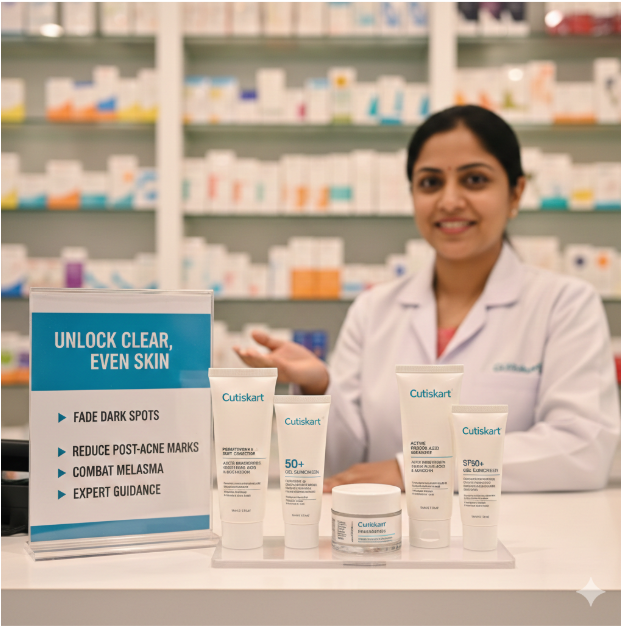
Unlike basic over-the-counter products, a true best pharmacy cream for pigmentation targets the root of the issue by managing melanin production and increasing skin turnover.
Dermatologists routinely recommend these high-performance actives found on Cutiskart:
- Hydroquinone: Often called the “gold standard” for stubborn dark spots and melasma, though it must be used under medical supervision.
- Kojic Acid & Arbutin: These reduce tyrosinase activity to effectively lighten acne marks and sun-induced spots.
- Retinoids: These speed up cell turnover, helping to fade post-acne pigmentation more quickly.
- Niacinamide & Azelaic Acid: Ideal for sensitive skin, these ingredients calm inflammation while providing gentle brightening.
OTC vs. Prescription: Which is the Best Pharmacy Cream for Pigmentation for You?
Choosing between an over-the-counter (OTC) option and a prescription-grade cream depends on the severity of your skin concern.
| Feature | OTC Pharmacy Creams | Prescription-Grade Creams |
| Active Strength | Lower concentrations (2-5%) | Higher-strength actives |
| Best For | Mild spots or maintenance | Deep pigmentation & melasma |
| Safety | Generally safer for daily use | Must have dermatologist guidance |
| Results | Slower but steady | Faster, visible results |
Read about Comprehensive Guide to Summer Moisturizers for Different Skin Types
Why Sunscreen is Your Cream’s Best Friend
Even the best pharmacy cream for pigmentation cannot compete with daily UV exposure. In fact, skipping sunscreen is the #1 reason why pigmentation treatments fail.
- Boosted Effectiveness: Using sunscreen can improve your cream’s results by 2-3 times.
- Failure Rate: Approximately 80% of treatment failures are linked directly to sun exposure.
- Expert Choice: For the humid Indian climate, a gel-based SPF 50+ formula usually works best.
This is why Cutiskart always emphasizes sunscreen alongside pigment correcting creams.
Avoiding Common Mistakes
Using strong pharmacy-grade products requires a careful approach. We often see pigmentation worsen when users:
- Overapply strong formulations or use them too frequently.
- Use steroid-based “fairness” products, which can cause skin thinning or rebound marks.
- Skip patch testing or use hydroquinone for an extended period without a break.
- Ignore sun protection, which triggers new melanin production.
What Results Should You Expect?
Pigmentation fades gradually; there are no safe shortcuts. Here is a general timeline for improvement:
- Mild spots/acne marks: 4 to 8 weeks.
- Moderate pigmentation: 8 to 12 weeks.
- Melasma: 3 to 6 months (often longer for full stability).
How Long Does It Take to See Results?
- Mild pigmentation or fresh acne marks: 4–8 weeks
- Moderate pigmentation: 8–12 weeks
- Melasma: 3–6 months (often longer for stability)
Consistency matters more than speed. Pigmentation fades gradually, and shortcuts often backfire.
Do You Need More Than Just Creams?
In many cases, yes.
The best results come from combining:
- Pharmacy creams
- Daily sunscreen
- Chemical peels
- Oral tranexamic acid (when indicated)
- Laser treatments for resistant melasma
This integrated approach delivers long-lasting, visible improvement, not temporary lightening.
Final Words: Do They Really Help?
Yes, the best pharmacy cream for pigmentation can be a game-changer when paired with lifestyle habits and professional guidance. For resistant cases, your dermatologist might combine these creams with chemical peels or laser treatments for long-lasting improvement.
Backed by over 25 years of expertise, Cutiskart ensures that Indian skin can achieve a clearer, more even tone safely and affordably.
FAQs – Pigmentation & Dark Spots
1. Can pharmacy creams really help reduce pigmentation and dark spots?
Yes. Pharmacy creams can significantly reduce pigmentation and dark spots when chosen correctly, used consistently, and combined with proper sun protection
2. Why is pigmentation more common in Indian skin types?
Indian skin tones have higher melanin levels, making them more prone to post-acne marks, sun spots, and melasma, especially with high UV exposure and pollution
3. What ingredients in pharmacy creams help fade pigmentation?
Common dermatologist-recommended ingredients include hydroquinone, kojic acid, arbutin, retinoids, niacinamide, and azelaic acid, which work on melanin control and skin renewal
4. What is the difference between OTC creams and prescription creams?
OTC creams have lower active strengths and are suitable for mild pigmentation, while prescription creams contain stronger actives and should be used under dermatologist supervision
5. How long does it take for pharmacy creams to show results?
Results depend on the severity:
Mild pigmentation: 4-8 weeks
Moderate pigmentation: 8-12 weeks
Melasma: 3-6 months or longer
Leave a Reply